


Estimated Reading Time: 8 Minutes
When you purchase a house in Costa Rica, you want to know what inventory stays with the house. During a property showing, there are always questions about what stays with the house for sale and what goes. Often, agents don’t even know what stays and whatnot, but will say anything to make the sale.
Honestly, I don’t really care what goes; I only care about what stays.
One day, the buyers (I acted here as a buyer’s rep) and I did a walk-through on the day of the closing. Horrified, we learn that the seller removed the awesome custom hardwood paneling and cabinetry in the study. They replaced it with cheap pine wood. Now what? The buyers fell in love with the house because of that wood paneling and custom-made cabinetry!

There are quite a few articles by realtors in the United States about this online. Check out “What’s a Fixture vs Personal Property” by Bill Gasset. Also, try “What Stays in the House and What Goes” by Anne Miller. Real estate law in the United States protects a buyer much better than it does in Costa Rica. Is it really that important what is a fixture and what is personal property? In Costa Rica, it’ll take you forever to sue a seller who took a fixture that they saw as personal property. So why even go there? A great general rule is that what is nailed down stays with the house for sale. Unless both parties agree.
Listing the property
When I go to a listing appointment (we have open listings here in the Central Valley), I always make sure what stays with the house for sale. I discuss with the owner each fixture or piece of personal property I see that might be an issue for staying with the house before I even take any photos.
Do curtains stay – it’s a good start for a buyer not having to worry about new curtains right away. Do lamps stay? I have seen sellers take all the lightbulbs with them. The twin chandeliers were inherited from great-uncle Pierre de Rigaud de Vaudreuil de Cavagnial, so they don’t stay? Do the mirrors in the bathrooms stay? Does the library in the office stay? I wrote another article two years ago about 7 items, for which it’s often unclear whether they stay with the house. But a library with hardwood wall panels and custom cabinetry, that’s a built-in, if you take it there will be a big hole in the wall… unless it’s replaced with something different.
When there is a question during or after a showing about a specific item, I just ask the seller and make a note. In some cases, you will find that the seller doesn’t really care, as long as you sell the house, and it will make a buyer very happy if a certain item stays. But it’s better to secure any item by including it in an inventory list.

Special details
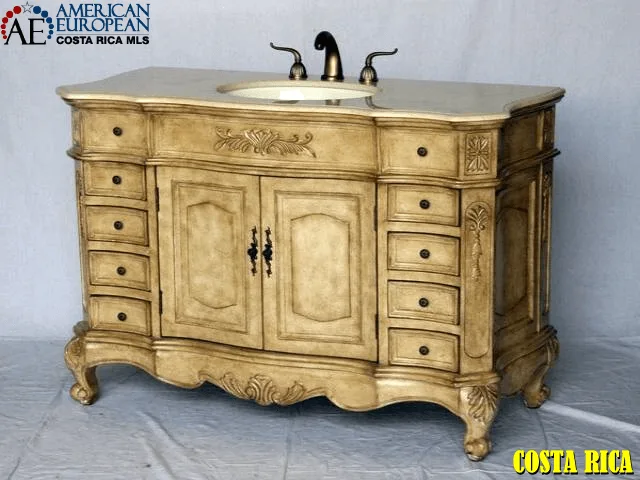
In certain style homes, you will find special details like antique furniture used for a bathroom cabinet, to fit an aquarium, or imported from India to serve as finishing details throughout the home.
When that happens, I take photos of those items and tell the seller that those details have to stay with the house for sale, as I won’t list the house without them. Sometimes, the sellers want to make it clear that something does not stay, so I include that in the offer.
My solution is to write anything important in the offer. For example, “The sale includes xxxx, and the inventory list of what stays with the house for sale shall be attached to the option to purchase sale agreement. And if it’s really special, I include a picture of the item.
Important Considerations
The “Shake Test”
A common rule of thumb is that if you turned the house upside down, anything that falls out is personal property (goes), and anything that stays attached is a fixture (stays).
The Contract is Key
Anything can be negotiated. If a seller wants to take a fixture (such as a special chandelier) or leave an appliance (such as a refrigerator), it must be explicitly stated in the purchase agreement.
Final Walkthrough
The buyer should confirm that all agreed-upon items are in place and that the house is “broom clean” before closing.
Left Behind Items: Any items left behind by the seller after closing generally become the property of the new owner.
New Construction
For new construction, assume nothing is included unless it is listed in the contract, as builder inventory homes may lack standard fixtures such as air conditioning, lamps, blinds, or screens.
Option to Purchase Sale Agreement
I’ll send the closing attorney the offer signed by both parties, and ask him/her to include those details in the Option to Purchase Sale Agreement: “The SELLER acknowledges that during the term of this option to purchase sale agreement and prior to delivery of the property to the BUYER, the maintenance of the property is the sole responsibility of the SELLER. As such, the SELLER must maintain the whole property in the same condition as it is today. If any maintenance is required to restore the property to its condition prior to closing, it shall be the sole responsibility and expense of the SELLER. An inventory list of everything that will stay on the property will be attached to the OPSA.”
Don’t close!
So let’s get back to the closing, with the missing library and its replacement in cheap pine. What, are you crazy? – The buyers screamed at me when I told them not to close during the walkthrough. How do you mean we don’t close? We’re living in a hotel and need to move in today. We have our container in customs, and we really need to close. The checks are cut, everything is ready to get signed, and we’re done. It’s only 2 hours away! God, what do we do now?
Ok, if you want to accept what the seller just did to you, which is entirely your decision, I’ll live with it. I think you made a mistake. Now is the time to play hardball and get what we negotiated with the seller. The option to purchase a sale agreement will cover you; let’s talk to your lawyer.
So we simply took pictures of the hole in the wall and searched for listing photos with the beautiful hardwood library. Then we took it all to the closing attorney to ask whether the buyer is legally protected from having to close. Should we request that the library be delivered to the house before closing? Can we request that the seller bear the cost of installation and any resulting damage? As a backup, we’d get a quote for replacing the paneling and cabinetry from the most expensive cabinetmaker in town.
Negotiate
Negotiating with the seller to close or not is usually very easy, as you are going to give the seller three options:
1. You do not close until the paneling and cabinetry are replaced
2. You deduct at least 20% of the cost of the house from the sales price, to be kept in escrow with your attorney, until new paneling and cabinetry are installed and paid for by the funds held in escrow.
3. You do not close at all.

Final Decision
The buyers decided to pay for the replacement and close. This was their decision, and I did my job. I hate it when that happens, though.
I have walked out of closings before. Make sure the agreement shows what stays with the house for sale before you sign the option to purchase sale agreement.
This story is not hypothetical; it’s a real story that shows how important it is to always write up an inventory list of what stays with the house for sale.
Feel free to comment on this blog and share this article on your social media. Would you like to learn more about buying property in Costa Rica? Then request a Zoom meeting with me now.